Content Team
AI technology experts specializing in face swap research and digital content creation.
In the rapidly developing field of digital content creation, voice clone technology is not only a novelty, but also a basic pillar of modern narrative. It usually works with high-end video intensifiers to produce broadcast quality narrative. As content creators, marketers and filmmakers strive to break through the saturated Internet noise, the ability to synthesize human like audio and combine it with the original visual effect is no longer a luxury, but a necessity. The integration of generative AI tools allows a workflow, and creators can manipulate reality to meet their narrative needs, from changing the identity of actors to restoring the clarity of file segments. This comprehensive guide deeply discusses the mechanism of three revolutionary technologies: the hearing accuracy of voice clone, the visual recovery ability of video upscale and the narrative flexibility of role replacement. We will explore how these tools can not only save time and budget, but also release creative possibilities that could not have been achieved without Hollywood studio infrastructure before. Whether you want to localize content for global audiences, recreate retro fragments, or create new roles, understanding the synergy between these AI driven solutions is the key to maintaining a leading position in the digital Renaissance.
The concept of digital audio synthesis has developed from robot monotonous text to voice system in the early twenty-first Century for several light-years. Today, speech cloning technology represents the peak of neural network application in audio processing. It works by analyzing the unique spectrum characteristics of the source sound -- pitch, rhythm, timbre and emotional changes -- and mapping them to the target script. This ability has completely changed content localization and post production. Imagine making a video in English. In a few minutes, the same "actor" can speak fluent Spanish or mandarin without entering the studio. That's the power of complex voice clone.
However, the practicability of this technology goes far beyond translation. For independent creators and marketing institutions, consistency is the king. Usually, due to changes in the script, it is necessary to re shoot or re record, but the original talents are not available. A powerful voice clone tool allows seamless "pick up" lines, which cannot be distinguished from the original recording. In addition, when combined with lip synchronization technology, the illusion becomes complete; Adjust the visual movement of the speaker's mouth to match the new audio track, eliminating the harsh "dubbing film" effect that often destroys the audience's immersion.
In order to achieve the best effect of speech cloning, the quality of input data is crucial. The clean and noiseless samples of target speech are the basic facts of AI model. Advanced tools now provide fine control, allowing users to adjust the "stability" and "similarity" of generated voice. High stability ensures a consistent tone suitable for documentaries or teaching videos, while low stability may introduce the natural changes and breathability needed for dramatic narrative. When we integrate these auditory tools, we must also consider the visual background. A perfect voice needs a perfect face, which is where tools such as face swap and facial expression change work, ensuring that visual emotion matches audio intensity. By mastering voice clone, the creators basically get the ability to guide actors who are not even in the room, and expand their content production to an unprecedented level.

Although audio carries the emotional weight of narration, the visual clarity determines its credibility. In the era of 4K and 8K displays becoming the standard, low resolution content is immediately regarded as unprofessional by viewers. This is where video upscale become an indispensable asset in the content strategist's toolkit. Unlike the traditional upgrade that simply stretches pixels and causes fuzzy chaos, the video upgrade driven by AI uses deep learning to predict and inject new details into the shot. They analyzed millions of images to understand what the texture should look like - whether it's the fabric of the shirt, the wood grain or the pores on the skin - and hallucinated these details with amazing accuracy.
The application of video enhancer is not only to improve the resolution. These tools usually include a set of repair functions to solve common video artifact problems. For example, old lenses or videos taken in low light are usually affected by obvious digital noise. A capable upgrader will perform denoising and blurring at the same time, sharpening the edge, and will not produce the artificial "halo" effect common in traditional editing software. This is particularly important when user generated content (UGC) or archive clips are reused for modern commercial purposes.
In addition, the integration of watermark remover or video background remover and other related tools simplifies the workflow. Usually, creators need to clean up the material before upgrading and integrating it into the final project. By removing the distracted date stamp or disordered background, the scaler can focus its processing power on the theme, so as to get clearer output. For creators who use animation or fast social media clips, the ability to use GIF face swap or upgrade technology to convert low-resolution GIF to high-definition video loop has opened up a new way for meme marketing and viral content creation. The goal of using the video upscaler is not just to make the image bigger; This is to restore the suspension of doubts destroyed by low quality. By ensuring that every pixel is clear, you can prepare the canvas for more complex operations such as video character replacement or environment conversion.

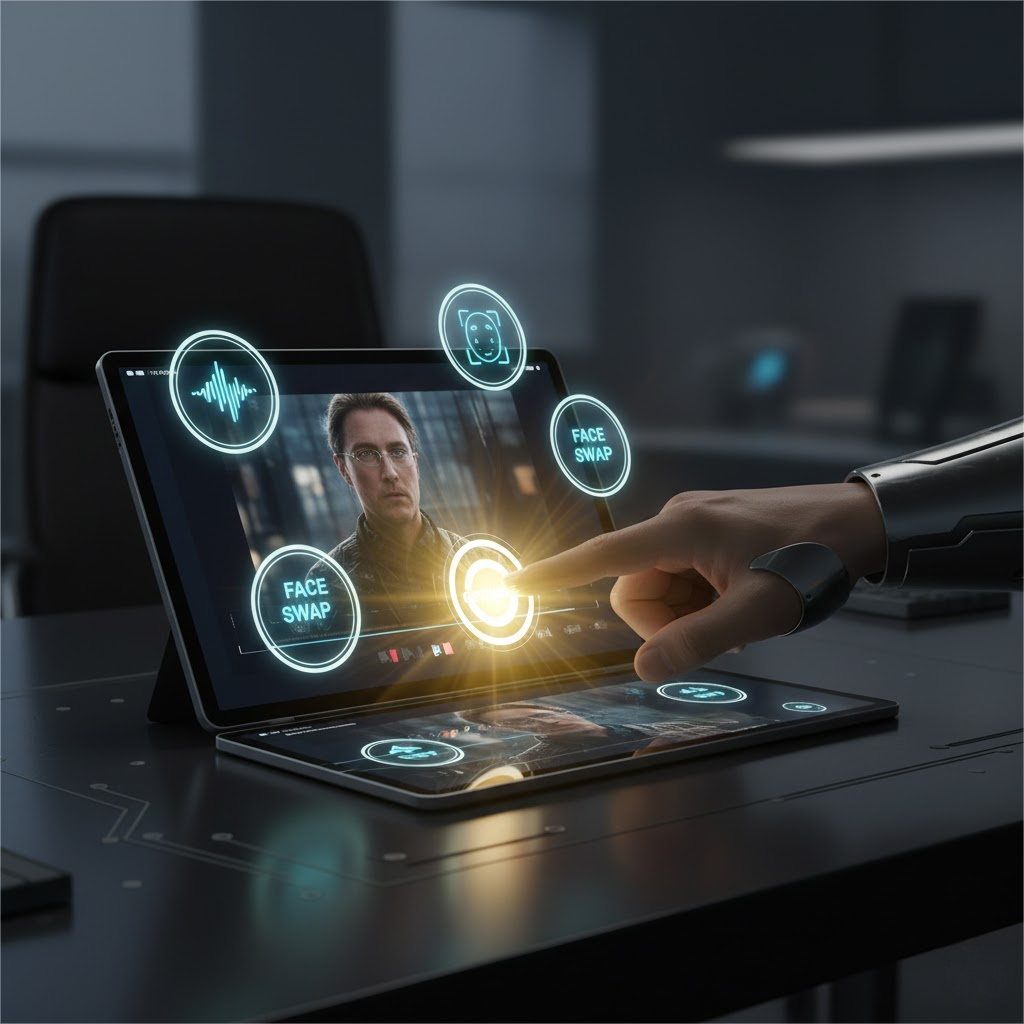
On the complexity ladder, video character replacement represents the frontier of synthetic media. This technology goes beyond simple editing; It allows to completely replace the identity of the actor in the mobile scene. Different from the standard photo face swap processing static pixels, the video character replacement must consider 3D geometry, lighting changes, occlusion (when the object passes in front of the face) and the elasticity of the skin when speaking. This is the real power of generative AI. It uses advanced algorithms in tools like VEO 3.1 or nano banana pro to map new identities to existing performance with frame by frame accuracy.
The use cases of video character replacement are very wide and have commercial significance. In advertising, a brand can shoot an advertisement, and then use this technology to exchange cultural related actors for different population markets, thereby significantly reducing production costs. In the field of entertainment and imitation, it allows to create content and re imagine classic scenes with new protagonists. However, it needs more than a switch button to achieve seamless results. It usually involves a combination of a variety of tools: a video face swap engine for processing facial features, and an image intensifier to ensure that the new face matches the resolution and texture of the original lens.
One of the most challenging aspects of role replacement is to maintain the integrity of the background and the seamless integration of the neck and mandible. The advanced AI model now combines the logic of the background remover to intelligently isolate objects and ensure that the exchanged "surgery" does not penetrate into the environment. In addition, if the shape of the source character is significantly different, AI may need to adjust the skeleton tracking. That's why video character replacement is considered as a whole discipline. It's not just about sticking a face; It's about simulating human existence. If the operation is correct, the audience should not be able to distinguish the role generated by AI from the real human actor. This technology enables creators to project their videos in post production, providing flexibility that was previously unimaginable.

When these separate technologies - voice clone, video upgrading and video character replacement - are integrated into a unified workflow, the real magic of AI content creation occurs. A disjointed video with crisp voice but blurred vision, or a high-definition face but lips closed synchronously, will not be able to attract the audience's attention. The goal is complete sensory coordination. For example, creators may first use faceswap-ai.io to choose perfect visual recognition for their speakers. Once the visual role is established through video face swap, they will use the voice clone tool to generate script reading that matches the age and background of the role's perception.
After the basic assets are generated, the refinement phase begins. If the original lens is from a camera with low quality, a video intensifier will be applied to make it meet modern standards. In this stage, the facial expression changer is used to make subtle adjustments to ensure that the non-verbal cues are consistent with the emotion of the cloned voice. Maybe the script requires a smile where the original actor frowns; AI can seamlessly correct this kind of micro expression. Even if it's the final touch up, such as using the watermark remover to clean up inventory assets or using the video background remover to place the role in the virtual studio, it's also an important step in polishing the final product.
Finally, platforms like faceswap-ai.io are becoming the central hub of these functions, providing a set of tools to democratize high-end production effects. The future of content creation belongs to those who can effectively choreograph these tools. By understanding the interaction between voice clone and video character replacement, and using video upgrades to improve the results, you are not only editing videos; You are engineering reality. This holistic approach ensures that every second of your content is optimized for participation, authority and transformation, setting a new standard for the possibilities in the digital field.
Expert Review: This article was written by Dylan Lee, our editorial team.
Methodology: All product comparisons and reviews are based on hands-on testing and independent research. We may earn affiliate commissions (at no extra cost to you) from some links.
Last Updated: December 11, 2025